
Louisiana does not require a state tattoo artist license; however, you must be registered as a Commercial Body Artist. Individual registration costs $100.
Registrations expire on December 31st of every year and must be renewed annually. There is no additional fee for renewed registrations.
Registration
To register as a Commercial Body Artist, you must provide the following to the Louisiana Department of Health:
1
Registration or Renewal Fee
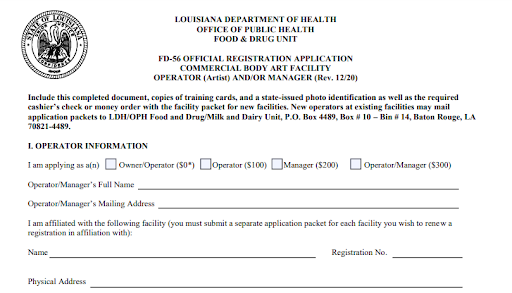
On this Louisiana Department of Health form, you will be able to indicate whether you are an independent tattoo artist owner/operator, an operator (this requires a $100 fee), a manager (with a $200 fee) or an operator/manager ($300 fee).
Are you an operator, owner, or manager? According to the LDH Registration page, you can figure it out based on these designations:
"An operator is any person who performs commercial body art (tattooing, permanent makeup or cosmetics, or body piercing) on human subjects.
“An owner is what it sounds like--the proprietor, president, or managing member, depending on the business organization of a commercial body art facility.
“A manager is a person designated by the owner of a facility to run the day-to-day operations of a commercial body art facility. It is NOT required for a facility to have a manager, but note that if an owner chooses to specify an individual as a manager for the facility, managers fall under a different fee schedule from operators (see FEE SCHEDULES, below). Managers also do not have to be operators, and owners do not have to be operators either."
You will need to provide information about the tattoo facility and shop owners on this required paperwork, even if you are only applying for an individual license.
Here are the links to the documents you'll need as a tattoo artist applicant:
2
State ID
To become a tattoo artist, you will also need to provide a state-issued ID that has your name, your birth date, and an expiration date.
3
Training Cards
Several types of training are necessary to obtain an individual license as a tattoo artist or body piercing professional from the Department of Health.
You will need CPR, First Aid, and Bloodborne Pathogens Training.
You need to make sure these courses were taken within 30 days of application. If not, they will be considered invalid. All training cards must have clear expiration dates.
Bloodborne Pathogens Training
Of these, the Bloodborne Pathogens training can be completed online. However, you need to make sure you are taking a tattoo artist course that is verified by the Louisiana State Board of Health. Otherwise, the credits could be invalidated.
Bloodborne pathogens training for tattoo artists covers topics such as disease transmission, infection control procedures, and how to properly dispose of tattoo equipment.
The training also covers the tattoo artist's legal responsibilities under the Occupational Safety and Health Administration (OSHA) regulations.
Find a list of registered courses for licensing here.
CPR
In a typical CPR course, you will learn how to provide CPR to an adult, child, and infant. The activity takes place in a classroom setting with a mannequin. You will also learn how to use an automated external defibrillator (AED). Most importantly, you will learn when to provide CPR and when it is appropriate to call 911.
Many states have their own state statutes regarding the administration of CPR by tattoo artists. In some cases, a tattoo artist may be required to obtain consent from the client before beginning the procedure. However, in most cases, the tattoo artist is not required to obtain consent from the client before beginning CPR.
First Aid
This course will cover basic concepts in first aid and emergency care specifically related to the task of tattooing.
The shop owner or a designated body piercer/cosmetologist will be issued a certificate upon successful completion of the course.
Basic topics covered include: emergency care for shock, fainting, seizures, uncontrolled bleeding; wound dressing and bandaging; care for infection; safely transporting an injured person; and emergency numbers for paramedics/police/fire.
Note:
Out-of-state licenses can be used for events only. Out-of-state operators must provide copies of current first aid, CPR, and bloodborne pathogens training along with any certifications, permits, or licenses to the event organizer.
If your county has additional regulations for tattooing or permanent makeup, you can find them here.
Turn in Your Application
Applications can be sent to:
LDH/OPH Food and Drug/Milk and Dairy Unit
P.O. Box 4489
Box #10 – Bin #14
Baton Rouge, LA
70821-4489
You should receive your active registration within 8-10 days of submitting your application. However, not all Louisiana offices are currently open, so there may be some delay.
Requirements for Tattoo Licensed Facility Registration
If you are already a person performing tattoos and permanent makeup services and wish to open a facility engaging in these services to extend your professional reach, there are a few other things you need to know.
In general, all tattoo shops should have a permit from the Louisiana Department of Health. However, no individual license is required.
This regulation does not cover activities that are defined as medical procedures by a state medical board. Commercial body art (CBA) facilities are prohibited from engaging in medical procedures.
To open a new facility, shop owners will need to supply: |
|---|
A completed FD-1Ba Plans Review Questionnaire |
A copy of a water bill |
A copy of a recent negative spore test for the autoclave |
A copy of a contract with a sharps waste transporter |
A copy of the permit for a private sewage system (if applicable) |
A copy of your proposed aftercare instructions for all said tasks that will be completed at the facility |
To open a new facility, shop owners will need to supply:
- A completed FD-1Ba Plans Review Questionnaire
- A copy of a water bill
- A copy of a recent negative spore test for the autoclave
- A copy of a contract with a sharps waste transporter
- A copy of the permit for a private sewage system (if applicable)
- A copy of your proposed aftercare instructions for all said tasks that will be completed at the facility
Note:
This advice does not constitute legal advice. Aspiring shop owners should always check with either the statutes set in place by the local city or county or with a legal professional in their area.
Things You Should Know:
According to state statutes, it is illegal to tattoo or perform any kind of commercial body art on anyone under the age of 18 without consent of an accompanying parent.
Things You Should Know:
According to state statutes, it is illegal to tattoo or perform any kind of commercial body art on anyone under the age of 18 without consent of an accompanying parent.
Louisiana Body Art FAQs
Yes, you need to be officially registered with the Louisiana Department of Health (LDH) to legally work as a tattoo artist in the state.
While Louisiana doesn’t issue a “tattoo license” in the traditional sense (like a cosmetology or barbering license), it requires all tattoo artists to register as Commercial Body Art Operators. So, functionally, this registration acts as your license.
Tattoo artists must submit an application (Form FD-56), pay a registration fee, and provide proof of specific health and safety training. In addition to the artist's registration, the tattoo studio must also be registered with LDH and have a valid facility permit. Tattooing without both the personal registration and a licensed shop is considered illegal.Tattooing in Louisiana is regulated under state law and the Louisiana Sanitary Code, specifically Title 51, Part XXVIII. The primary focus of these laws is to protect public health and safety.
Here are the key legal points:
In Louisiana, becoming a tattoo artist doesn’t require a college degree or formal apprenticeship, but you do need specific health and safety credentials before you can be registered with the state.
Here’s what you need:
In short, your credentials are focused on health and safety compliance, not artistic skill testing—so it’s up to you to seek out training and practice in the craft itself.
Some states make it much easier than others to legally become a tattoo artist. For example, there is no Idaho tattoo license, while states like Oregon and Alaska have very strict training regulations.
Louisiana falls somewhere in the middle. You need to register with the state, but there are no exams, no required apprenticeship, and no artistic assessment. Once you complete short health-related courses (Bloodborne Pathogens, CPR, and First Aid), you can register, pay your fee, and legally start tattooing in a permitted studio.
Public Health Regulations for Commercial Body Art can be found here.
Louisiana State Legislature Commercial Body Art Regulation can be found here.
Updated Coronavirus information can be found here.
https://ldh.la.gov/assets/oph/Center-EH/sanitarian/fooddrug/commercial_body_art/newapps/FD-56.pdf
https://ldh.la.gov/assets/oph/Center-EH/sanitarian/fooddrug/commercial_body_art/CBA_Trainers.pdf
https://ldh.la.gov/assets/oph/Center-EH/sanitarian/fooddrug/commercial_body_art/newapps/FD-56a.pdf
https://ldh.la.gov/assets/oph/Center-EH/sanitarian/fooddrug/commercial_body_art/PartXXVIIITitle51.pdf
https://www.legis.la.gov/Legis/Law.aspx?p=y&d=98355
https://ldh.la.gov/page/commercial-body-art
https://ldh.la.gov/page/districts
https://ldh.la.gov/page/commercial-body-art
Infection control course by state: https://courseforbbp.com/states
For further assistance finding hepatitis B vaccine: https://www.cvs.com/minuteclinic/services/hepatitis-b
Prepare for a Tattooing Career with the Artist Accelerator Program
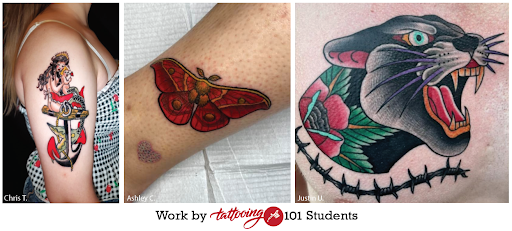
Learning the steps you need to take to get licensed is an important step in your journey, but it can also be pretty eye-opening to how difficult tattooing can be. Without the right knowledge, it’s impossible to level up your skills and become a professional tattoo artist.
However, finding the straight-forward information you need to progress is difficult. And with so much out there online, it’s hard to avoid picking up bad habits from incorrect and outdated resources.
This is one of the biggest struggles new tattooers face, and too many talented artists have given up their goal of getting into tattooing because of the years it would take to unlearn their bad habits.
That’s why aspiring artists are learning to tattoo with the Artist Accelerator Program’s structured course. As a student, you learn every step of the tattooing process from professional artists with the experience and advice you need to build your skills and create incredible tattoos.
With the Artist Accelerator, you can stop wasting time searching through incorrect information. You just get the clear, easy-to-understand lessons you need to start improving fast… along with support and personalized feedback from professional artists in our online Mastermind group.
Over 7500 students have already gone through the course, with many of them opening up their own studios. If you want to join them and learn the skills you need to start tattooing full-time faster…
Click here to learn more about the Artist Accelerator Program.